Last reviewed by Haruka Fujimoto · March 2026 | Reading time: 12 minutes
Are you struggling to keep up with native Japanese speakers? Do you find yourself understanding written Japanese but feeling lost when listening to real conversations? If so, shadowing might just be the breakthrough you’ve been looking for. At NihongoKnow, years of teaching experience have convinced us that this is the single most effective technique for developing natural Japanese speech.
✅ Quick Answer: What is Shadowing, According to NihongoKnow?
Shadowing is a powerful language-learning technique where you repeat Japanese audio in real time, mimicking native speech patterns exactly as you hear them.
At NihongoKnow, we don’t just see shadowing as a practice method, it’s a core element of our “Learn Japanese with Your Brain” methodology. This practice dramatically improves listening comprehension, pronunciation accuracy, and speaking fluency. It’s especially effective for mastering the subtle pitch accent, natural rhythm, and authentic expressions that textbooks often miss.
Unlike traditional “repeat-after-me” exercises, shadowing requires you to speak simultaneously with the audio. This trains your brain to process Japanese at native speed while building the muscle memory needed for natural pronunciation, the fastest path to genuinely usable Japanese.
A note from Haruka: “I still remember one of my students, she’d been studying Japanese on her own for two years but froze every time a native speaker talked to her. I introduced shadowing in her third lesson. By week four, she called me almost in tears: ‘Haruka, I actually understood the announcement at the train station in Osaka.’ That moment is exactly why I teach.”
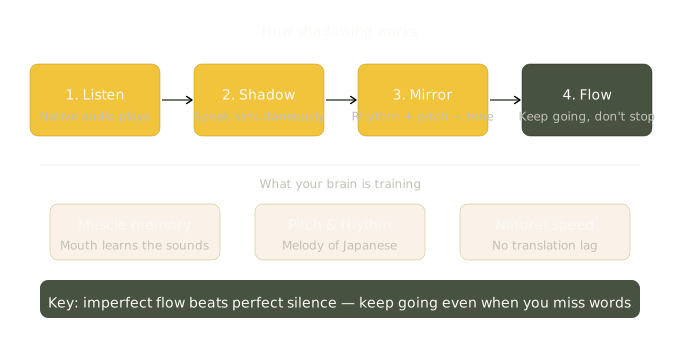
Shadowing is a simultaneous speaking practice method that originated in interpreter training programs. Here’s exactly how it works, and what we emphasize at NihongoKnow:
The Core Process
Listen to native Japanese audio (podcasts, anime, news, etc.).
Repeat exactly what you hear at the same time, no pausing or delays.
Mimic everything: pronunciation, pitch accent, speed, and even emotional tone.
Keep flowing with the speaker, even if you miss words. Maintaining rhythm is more important than perfection in the beginning.
Shadowing in a NihongoKnow Lesson
You can shadow alone, but in NihongoKnow lessons our instructors listen closely to your pronunciation and rhythm, giving precise, real-time feedback. This personalized attention accelerates your progress significantly.
Why It’s Called “Shadowing”
Think of yourself as a shadow following the original speaker. Just as a shadow mirrors every movement instantly, you mirror every sound, inflection, and rhythm pattern in real time.
This technique is widely used by professional interpreters, successful polyglots, and language teachers because it trains your brain to process language automatically, producing natural fluency instead of translated, choppy sentences.
Types of Shadowing Practice:
Phonetic Shadowing: Focus purely on sounds and pronunciation. Best for beginners.
Content Shadowing: Concentrate on understanding meaning while speaking. For advanced learners.
Selective Shadowing: Target specific elements like particles, verb endings, or pitch patterns.
Emotional Shadowing: Match the speaker’s tone, energy, and emotional expression.
🤔 Why is Shadowing Especially Effective for Japanese Learners?
Haruka’s take: “Growing up, I moved from Tokyo to Osaka at age 9. Suddenly the rhythm of the language around me felt completely foreign, same country, completely different music. That experience taught me that language isn’t just words; it’s sound, rhythm, and feeling. Shadowing recreates that kind of immersive exposure, even when you’re sitting at your desk in Vancouver.”
Japanese presents unique linguistic challenges that make shadowing particularly valuable compared to other languages. Our “Learn Japanese with Your Brain” method leans heavily on shadowing to work through these specific hurdles.
1. Mastering Complex Pitch Accent
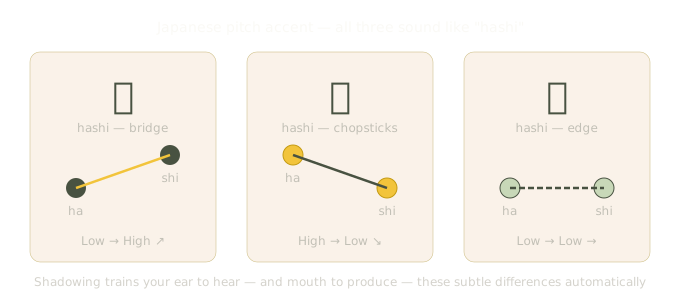
Unlike English stress patterns, Japanese uses pitch accent to distinguish word meanings. These subtle tonal differences are nearly impossible to master through reading alone.
Try saying these aloud:
橋 (はし – bridge) – Low-High pitch
箸 (はし – chopsticks) – High-Low pitch
端 (はし – edge) – Low-Low pitch
All three words look identical in romaji but have completely different meanings based on pitch accent. Shadowing helps you internalize these patterns naturally.
2. Particle Precision in Fast Speech
Japanese particles (は, が, を, に, で, から, まで) are often shortened, mumbled, or blended in natural conversation. Textbook examples rarely prepare you for how these sound in real speech.
Real Speech Examples (Listen closely to the nuances!):
それは → それわ (は pronounced “wa”)
何をしている → 何してる (を often dropped)
~ということ → ~ってこと (contracted to って)
3. Internalizing Grammar Patterns
Japanese sentence structure and verb conjugations become automatic through shadowing, rather than through conscious application of grammar rules.
Pattern Recognition:
Polite forms: です/ます endings
Past tense: ~た/~だ variations
Negative forms: ~ない/~ません patterns
Keigo (honorific): respectful and humble expressions
4. Understanding Cultural Communication Styles
Shadowing exposes you to authentic Japanese communication patterns, including appropriate formality levels, natural conversation fillers (あの, えっと, そうですね), emotional expressions, and regional speaking styles.
🧠 Science-Backed Benefits: 10 Surprising Ways Shadowing Boosts Your Japanese
Shadowing isn’t just a practice method — it’s a technique with real, evidence-backed benefits, and it’s a cornerstone of our “Learn Japanese with Your Brain” methodology.
Dramatically Improves Listening Comprehension: Shadowing trains your brain to process Japanese at native speed. NihongoKnow students who shadow daily consistently report that JLPT listening, once their biggest weak point, starts to feel manageable within 6–8 weeks. This tracks with classroom research showing that regular shadowing meaningfully improves phoneme perception and listening comprehension, particularly for beginner-to-intermediate learners (Hamada, Y. (2016). “Shadowing: Who benefits and how?” Language Teaching Research, 20(1), 35–52).
Builds muscle memory for native-like pronunciation. Your mouth muscles learn the physical movements needed for Japanese sounds, creating automatic rather than conscious articulation.
Masters natural intonation and pitch accent. Japanese melody and rhythm become internalized through repetition, helping you avoid the “robotic textbook” speaking style.
Increases speaking speed and confidence. Regular shadowing reduces hesitation and filler words, building fluency rather than just accuracy.
Eliminates mental translation dependency. Shadowing forces direct Japanese processing, breaking the habit of translating through English first.
Passively internalizes grammar patterns. Complex structures become automatic through exposure and repetition.
Strengthens vocabulary retention through context. Words learned through shadowing stick better because they’re tied to sound, emotion, and situation.
Excellent JLPT listening preparation. Shadowing closely mirrors JLPT listening test conditions, improving both comprehension speed and accuracy.
Perfect for self-study. Unlike conversation practice, shadowing needs no partner or scheduling, just audio and headphones, anytime, anywhere.
Accelerates overall language acquisition. Shadowing activates multiple language-processing areas simultaneously, building stronger neural pathways for Japanese.
🎯 The NihongoKnow Way: Your Complete Step-by-Step Guide to Effective Shadowing
Phase 1: Foundation Building (Weeks 1–2)
Step 1: Choose Appropriate Audio Materials Select materials that match your current level.
Step 2: Start with Scripted Shadowing Begin by using a script to help you connect sounds with written words.
💡 Before you start: This step assumes you can read the transcript without hesitation. Before shadowing becomes truly effective, being able to read hiragana naturally makes a significant difference — when you can read the script without stopping to decode it, your brain is free to focus on sound and rhythm, which is exactly what shadowing trains.
Pre-listen to your chosen audio 2–3 times to get a general sense of the content.
Read the transcript aloud several times to familiarize yourself with the words and structure.
Listen while reading the transcript, noticing how the sounds match the text.
Speak along with the audio, following the text, trying to synchronize your voice with the speaker’s.
Focus on rhythm over perfect pronunciation initially — it’s okay to mumble or miss words, just keep the flow.
Recommended Practice Schedule
Practice for 5–10 minutes daily.
Stick to the same material for 3–5 days before switching.
Prioritize consistency over duration.
Step 3: Optimize Your Audio Setup
Use good headphones for clear audio distinction of subtle sounds.
Find a quiet practice space where you can speak aloud without distraction.
Record yourself periodically (your phone’s voice recorder is fine) for later comparison.
Keep water nearby — shadowing can be vocally demanding.
Phase 2: Skill Development (Weeks 3–6)
Step 4: Transition to Blind Shadowing Once comfortable with the script, try shadowing without looking at it.
Listen without reading the transcript.
Mimic every sound in real time.
Don’t worry about understanding every word initially — your focus is on the sound.
Maintain the flow even when you miss parts.
Focus on prosody (rhythm, stress, intonation) — the music of the language.
Step 5: Progressively Increase Difficulty
Gradually increase audio speed: start at 0.8x, progress to 1.0x, then 1.2x.
Use longer audio segments: move from 30 seconds to 2 minutes, then 5+ minutes.
Introduce more complex vocabulary and grammar.
Practice with different speakers and accents to broaden your listening skills.
Step 6: Self-Monitoring and Correction
Record your shadowing weekly.
Compare your recording with the original audio and listen critically.
Identify specific problem areas: pitch accent errors, timing issues, pronunciation difficulties, rhythm disruptions.
Focus your next practice on those identified weaknesses.
Phase 3: Mastery and Automation (Weeks 7+)
Step 7: Advanced Shadowing Techniques
Selective Shadowing: shadow only particles and connectors, or focus exclusively on verb endings, conjugations, or pitch-accent patterns.
Emotional Shadowing: match the speaker’s emotional tone (anger, joy, sadness), mirror their energy, and practice different registers (formal, casual, excited, sad).
Content Shadowing: shadow while focusing on meaning, summarize the content afterward, and use shadowed phrases in your own conversations.
Step 8: Integrate with Real Communication
Actively use shadowed phrases and expressions in conversation practice.
Consciously apply natural intonation patterns when speaking Japanese.
Recognize shadowed expressions in real Japanese media (anime, dramas, news).
❗ Common Mistakes to Avoid (and How NihongoKnow Helps You Fix Them)
❌ Mistake #1: Pausing Between WordsProblem: Breaking the natural speech flow to process individual words hinders fluency development. NihongoKnow instructor’s solution: “Embrace imperfection and prioritize rhythm. It’s better to mumble through a difficult part than to stop completely. Even if your mouth doesn’t articulate perfectly at first, your brain is still recognizing the sound patterns, smoother speech follows over time.”
❌ Mistake #2: Whispering or Silent PracticeProblem: Not engaging the vocal muscles needed for actual speech production. NihongoKnow instructor’s solution: “Even if you feel self-conscious, speak at full conversational volume, activating your vocal muscles is essential for building muscle memory. If privacy is an issue, find a quiet space at home or a secluded spot outdoors. In NihongoKnow’s online lessons, you’ll have a comfortable environment to practice speaking freely.”
❌ Mistake #3: Focusing Only on TranslationProblem: Getting stuck trying to understand every word instead of building fluency. NihongoKnow instructor’s solution: “In the early stages, trust that understanding will develop naturally. Prioritize mimicking sound and rhythm first, you can always review the script, infer meaning from context, or check a dictionary afterward.”
❌ Mistake #4: Using Audio That’s Too DifficultProblem: Becoming frustrated and giving up due to overwhelming complexity. NihongoKnow instructor’s solution: “The secret is to start with content that feels almost too easy, and build confidence before increasing difficulty. At NihongoKnow, we assess your current level and recommend materials that keep the learning curve smooth and enjoyable.”
❌ Mistake #5: Inconsistent Practice ScheduleProblem: Sporadic long sessions instead of regular short practice. NihongoKnow instructor’s solution: “Instead of two-hour weekend sessions, commit to 10–15 minutes daily. Consistency is what builds the habit and tells your brain Japanese is a priority, that’s what accelerates progress. We can help you build a personalized study schedule during your NihongoKnow lessons.”
❌ Mistake #6: Ignoring Self-FeedbackProblem: Repeating the same pronunciation errors without noticing. NihongoKnow instructor’s solution: “Make it a habit to record yourself and compare it to native audio. You’ll catch pitch-accent discrepancies or unnatural rhythms you’d otherwise miss. In NihongoKnow lessons, our instructors give detailed feedback on your shadowing and guide you through specific improvements.”
❌ Mistake #7: Perfectionism ParalysisProblem: Refusing to continue until every word is perfect, leading to stagnation. NihongoKnow’s solution: “Perfection isn’t the goal, consistent, imperfect practice is. Progress comes from showing up and trying, not from waiting for a perfect, infrequent attempt. At NihongoKnow, mistakes are a valued part of the learning process.”
From Haruka’s classroom: “One thing I learned from my background in school psychology: perfectionism is often fear in disguise. I’ve worked with students with dyslexia and ADHD who’d been told ‘you’re not a language person.’ They became some of my most expressive Japanese speakers, because they stopped waiting to be perfect and just kept showing up. A parent once asked me, ‘Why does my child remember everything in your class but forget it everywhere else?’ The answer was simple: we made space for mistakes. Shadowing works the same way.”
Is shadowing suitable for complete beginners?
Absolutely! Start with very simple, slow audio like NHK News Web Easy or basic greetings. Even beginners can effectively shadow short phrases. The key is choosing appropriate materials, and if hiragana reading still feels slow, our [10-Day Hiragana Mastery workbook] can close that gap quickly before you begin.
Should I understand every word before I start shadowing?
No, it’s not necessary. The primary goal of shadowing is to develop your auditory processing and speaking fluency. Focus on mimicking the sounds and rhythm first, even if you don’t fully grasp every word’s meaning. You can always deepen your understanding by reviewing the script, inferring from context, or using a dictionary later.
Can I use anime or Japanese dramas for shadowing practice?
Yes, they can be highly effective! Especially if you can find them with scripts (subtitles) and if they are genres you genuinely enjoy. However, be mindful that speaking styles and speeds vary greatly. It’s often best to start with slice-of-life anime or dramas that feature more everyday conversations and relatively slower pacing. NihongoKnow can also guide you on selecting the best anime/drama for your shadowing practice.
How often should I practice shadowing for best results?
Consistency is key. It’s much more effective to practice for 10-15 minutes daily than to have sporadic, long sessions. Daily practice helps your brain solidify new linguistic habits and accelerate your overall progress.
What’s the difference between shadowing and regular repetition exercises?
The main difference lies in “simultaneity” and “flow.” In regular repetition, you speak after the audio stops. In shadowing, you speak simultaneously with the audio, mimicking it like a shadow. This trains your brain to process Japanese at native speed and helps you acquire natural rhythm and intonation.
Should I shadow the same content repeatedly or always use new material?
A balance of both is recommended. Repeating the same content helps solidify pronunciation and rhythm, internalizing patterns at an unconscious level. Using new material, on the other hand, expands your vocabulary and exposure to new expressions. We suggest practicing the same material for several days until you feel confident, then moving on to new content.
Can shadowing replace conversation practice with native speakers?
No, shadowing is a powerful supplementary tool for conversation practice, not a replacement. While it boosts listening and speaking fluency/accuracy, skills like formulating original thoughts, responding spontaneously, and adapting expressions in real-time can only be developed through actual conversation. Use the skills you gain from shadowing in NihongoKnow’s conversation lessons to truly enhance your output ability.
How do I know if I’m improving with shadowing practice?
You’ll notice improvements in several areas: The gap between your recorded voice and the original audio narrows, especially in pitch accent and rhythm. Your listening comprehension speed increases; you’ll understand conversations that previously sounded too fast. You’ll speak more smoothly, with fewer hesitations and more natural phrasing. Native speakers might start complimenting your pronunciation or fluency.
What should I do if I can’t keep up with the speaker?
Instead of repeatedly listening or getting frustrated trying to keep up, try these methods: Lower the material’s level: Choose audio that feels almost too easy for you. Reduce playback speed: Use an audio player with speed adjustment (start at 0.75x or 0.8x) and gradually increase. Start with shorter phrases: Focus on mastering short greetings or single words before tackling full sentences. Use the script: Reading along with the script can help you follow the sounds more easily.
Is it better to shadow with or without headphones?
We strongly recommend using headphones (especially noise-canceling ones). Headphones block out external noise and allow you to hear subtle nuances, pitch accents, and minute changes in sound more clearly. This significantly improves the accuracy of your mimicry.
Ready to Master “Usable Japanese” with Shadowing?
“When I started NihongoKnow, I had one goal: to be the teacher I always wished I’d had. Not someone who lectures at you, but someone who listens to how you sound, figures out exactly where you’re getting stuck, and helps you break through it.
Shadowing is powerful on your own. But having someone catch the pitch-accent error you can’t hear yet? That’s where the real breakthroughs happen.
Ready to find yours?
At NihongoKnow, our experienced instructors guide you through shadowing based on our ‘Learn Japanese with Your Brain’ methodology, tailored to your individual level. We’ll diagnose your weaknesses and support you every step of the way — from choosing the right materials to refining your technique.
It’s time to elevate your Japanese to the next level!
Haruka Fujimoto is the founder of NihongoKnow, a Japanese language school based in Vancouver, Canada.
With over 10 years of teaching experience and a background in school psychology, she specializes in helping English-speaking learners build real communication skills in Japanese through personalized, experience-based lessons.
Her approach combines coaching, behavioral science, and immersive language learning, focusing not on memorization, but on practical, usable Japanese.