

There’s a particular moment I look for at every meetup.
It usually happens during lunch, or in the middle of a game, or right when someone is mid-sentence trying to remember a word. Someone stops thinking about Japanese and starts using it. The language stops being the subject and becomes the medium.
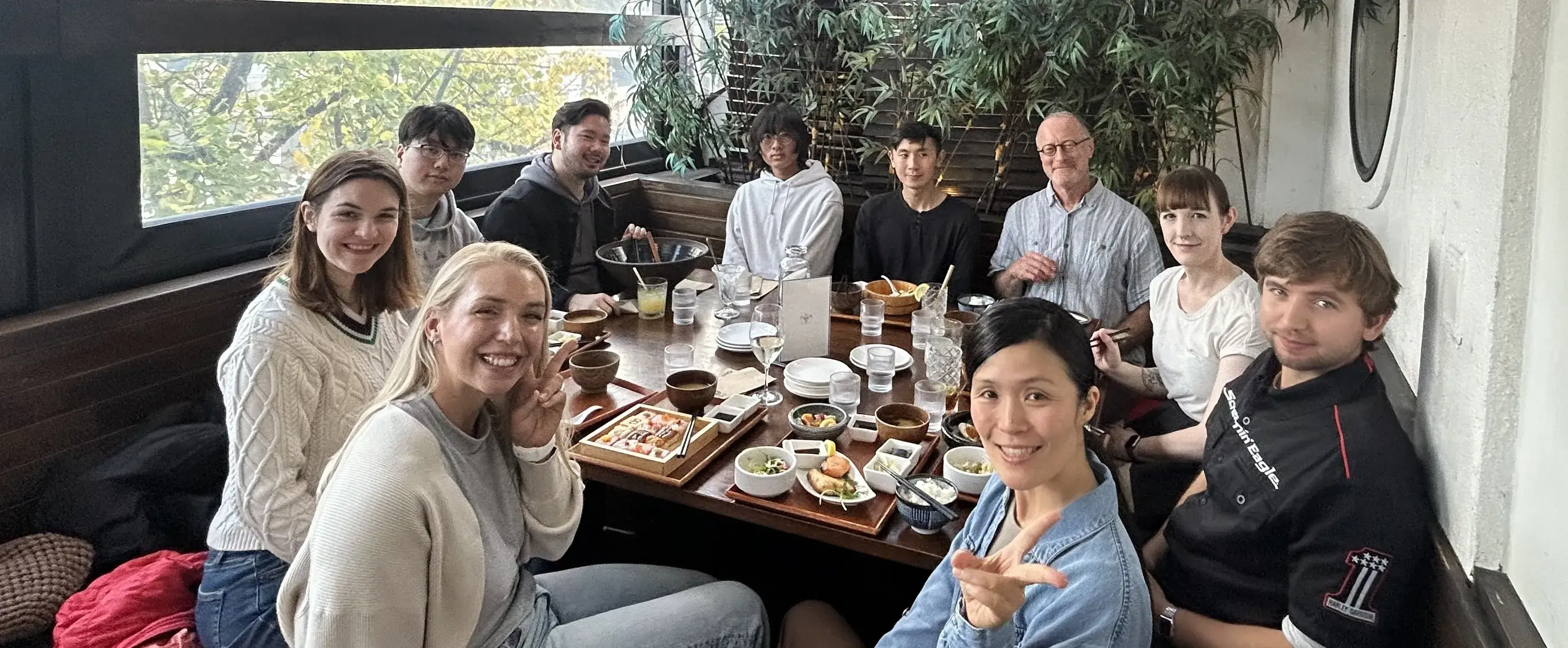
That moment happened multiple times on September 28, 2026, when I brought together intermediate and advanced Japanese learners in Vancouver for an afternoon of conversation, activities, and lunch. With nine students in the room, everyone had plenty of opportunities to speak, listen, and interact with different people throughout the afternoon.
And it reminded me why I keep organizing these afternoons.
Who This Meetup Was For

This session was designed for my intermediate and advanced students, roughly N3 to N1 level. Students who already have a foundation, but who don’t often get the chance to use Japanese with anyone other than their teacher.
That gap matters more than most people realize.
When you study one-on-one, you develop a particular rhythm with your teacher. You learn to anticipate each other. The conversation has a safety net built in.
Speaking with someone else — another learner, a restaurant staff member, a person whose speaking style you don’t know yet, is a genuinely different skill. And the only way to build it is to practice it.
We Built a Country Together
The main group activity was a challenge called Let’s Build a New Country.
Students were given this situation in Japanese:
「みなさんは、新(あたら)しい島(しま)を発見(はっけん)しました。
この島(しま)には、まだ国(くに)がありません。
今日(きょう)、みなさんが新(あたら)しい国(くに)を作(つく)ります。」


From there, they had to work together, entirely in Japanese, to decide what their country would look like. They created rules, debated how to allocate a budget, and responded to unexpected problems I introduced as the activity progressed.
There was no correct answer. That was the point.
When there’s no answer key, students stop filtering every sentence through grammar rules and start asking: What do I actually want to say? Japanese becomes a tool for solving a real problem, not a subject to be assessed.
Genna described it afterwards as “a perfect way to practice Japanese with other classmates” and named it one of her favourite parts of the day. What I noticed while watching was that everyone was genuinely engaged, not performing engagement, but actually thinking through decisions and explaining their reasoning to each other.
The Thing About Asking Questions

During the activity, Genna mentioned something that I keep coming back to.
She said she learned that it’s good to ask questions when you don’t know a word or phrase.
At beginner level, not knowing a word often means the conversation stops. At intermediate level, it doesn’t have to. You have enough language to ask for clarification, to rephrase, to keep moving.
「それはどういう意味(いみ)ですか?」
「もう一度(いちど)言(い)ってもらえますか?」
「〜ということですか?」
These aren’t signs of weakness. They’re exactly what fluent speakers do. Learning to use them naturally — without hesitation, without embarrassment — is one of the most important transitions in the intermediate stage.
What Gordon Noticed
Gordon joined primarily to practice speaking Japanese. Afterwards, he said the activities made it easy to meet new people and that it was great to see everyone in person again.
But the thing he found most valuable was something I didn’t plan for: simply hearing everyone speaking Japanese the whole time.
This is hard to manufacture in a classroom setting. When you’re surrounded by Japanese — not textbook audio, but real people in real conversation — your brain starts adjusting to it as the default mode of the room. You stop translating in your head and start responding.
That shift doesn’t happen overnight. But afternoons like this one accelerate it.

Lunch at RAISU
After the structured activities, we walked to RAISU, a Japanese restaurant in Vancouver’s Kitsilano neighbourhood. RAISU serves a range of Japanese dishes, including sushi, sashimi, izakaya-style dishes, and set meals.
Before the meetup, I contacted the restaurant and asked if the staff would be willing to speak with our group only in Japanese. They were happy to help, and they did it beautifully, using natural polite language and keigo throughout the meal.
What I loved most was watching the students take the lead.
In a classroom, even when I’m playing a character or a scenario, students know on some level that I’m their teacher. The stakes are contained. At a restaurant, the person across the counter isn’t there to support your language learning. They have other tables. They have things to do. You have a real reason to communicate clearly and quickly.
The students did exactly that, ordering, asking questions, responding to the staff’s follow-ups.
And the restaurant staff told me afterwards that they were genuinely surprised by how fluent everyone was.
That moment meant a lot to me. Not because I want my students to impress people, but because they heard it. From someone with no reason to flatter them.
Sarah specifically mentioned the lunch at RAISU in her feedback. Genna also named it as one of her favourite parts. Gordon mentioned the socializing at the restaurant as something he enjoyed. After the meal, we stayed for another two hours, no worksheet, no timer, just conversation.
That’s when I knew the afternoon had worked.
What the Students Said
After the meetup, I asked everyone to share honest feedback.
Sarah:
“I enjoyed getting to know other people and speaking in Japanese. It made me feel happy and like I got lots of practice!”
Gordon:
“It was great to see people again in person, and the activities made it easy to meet new people.”
Genna:
“So fun!”
Several students mentioned feeling a little more confident after the experience. One said the meetup helped them realize how useful it is to ask questions in the moment rather than letting gaps derail the conversation.
And my favourite response was simply: “Let’s do it again soon!”
Why This Matters at the Intermediate Stage
At the beginning of learning Japanese, progress is visible. New vocabulary. New grammar. New sounds. You can measure it.
At the intermediate stage, progress becomes harder to see, but the challenges become more interesting.
You may know a lot of Japanese and still hesitate to speak in a group. You may understand what someone is saying but not know how to respond in the moment. You may have an opinion and not know how to explain why.
These aren’t grammar problems. They’re fluency problems. And they require a different kind of practice, less structured, more unpredictable, closer to what actual conversation feels like.
That’s what a meetup like this provides.
Not perfect Japanese. Not a safe environment to rehearse prepared sentences.
Just a group of people, a shared challenge, and a reason to keep talking.
About Our Meetups
Our meetups are currently primarily for NihongoKnow students, though I’m exploring ways to expand access in the future.
If you’re learning Japanese in Vancouver and would like to hear about upcoming opportunities, feel free to get in touch.
Thank you to Sarah, Gordon, Genna, and everyone who joined us for the afternoon. I’m very proud of all of you.
And yes, Genna, let’s do it again soon. 🙂


