
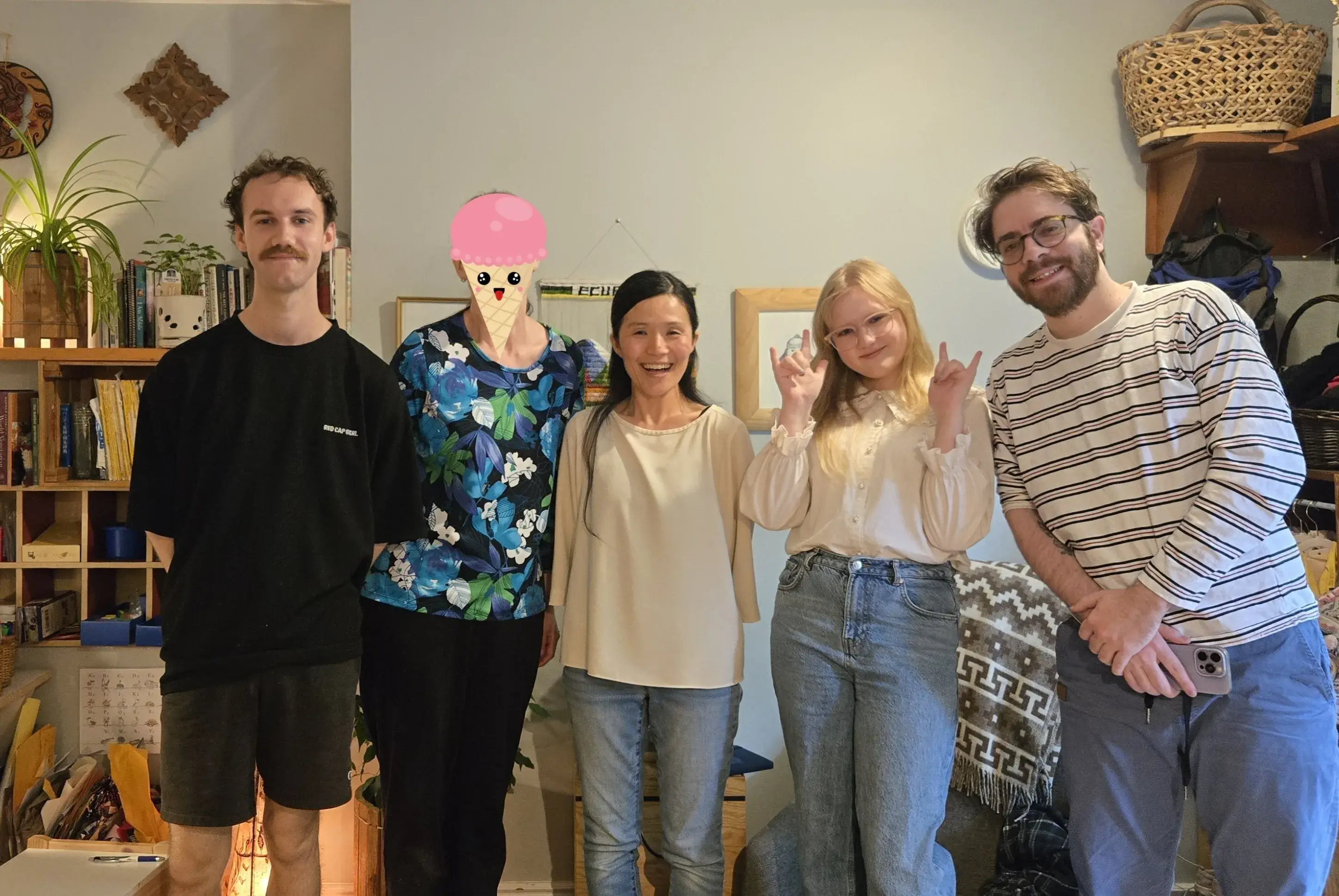
On July 25th, a small group of beginner Japanese learners got together in Vancouver for an in-person meetup, no textbooks, no worksheets, just a room full of people trying to introduce themselves in Japanese without looking at their notes.
I wasn’t sure what to expect going in. Beginner meetups can go two ways: either everyone’s too nervous to say much, or something clicks and the room actually starts talking. This one leaned hard toward the second.
Afterward, I asked everyone who came to share honest feedback, the good, the awkward, the parts that actually helped. Here’s what they said.
What the meetup actually looked like
Everyone came in for slightly different reasons, some wanted to meet other learners, most wanted to actually speak rather than study alone. What stood out in the feedback was how much the introductions mattered. Being asked to introduce yourself and others in Japanese, on the spot, with no script, turned out to be one of the most memorable parts of the day for several attendees.
The lesson behind the fun: mastering この・その・あの
Underneath the games and introductions, this meetup was really just a scaled-up version of something we do in every regular class, checking vocabulary and grammar while actually talking, not through a worksheet.
The grammar focus for the day was この・その・あの (kono / sono / ano), Japanese demonstratives, roughly “this,” “that (near you),” and “that (over there).” On paper, this looks simple. In practice, it’s one of the grammar points that takes most students noticeably longer to feel comfortable with, and the reason isn’t memorization, it’s that these words only make sense in relation to where you and the other person actually are. You can’t really learn them from a textbook page; you have to feel the distance.
So instead of explaining the rule, we practiced it through games, pointing things out, describing where people and objects were relative to each other, all while doing self-introductions and introducing other people in the group. Students got to physically experience when to use each word, in the moment, rather than trying to recall a grammar chart. By the end of the meetup, everyone in the room was using この・その・あの naturally and with real confidence, including students who’d been stuck on it for a while before this.
One small adjustment happened the day before the event, too: when a registered student had to drop out last minute, I revised the day’s content to fit the actual level of the group that would show up, rather than running the original plan as-is. That’s the same approach I use in one-on-one lessons, the plan serves the students in the room, not the other way around.
If you are curious about grammar, you can also check ; 🗣️ Mastering Japanese “Kosoado” Words: Expressing Distance and Perspective Naturally
What beginners actually said

Judith, who joined from Vancouver, came to practice speaking and said the event was well run from start to finish: “Haruka sensei created a very fun interactive event… She used the time extremely well.” She left feeling a little more confident using Japanese than when she walked in.
Tess, who came to meet other Japanese learners, appreciated the smaller group size: “A lot of fun! I enjoyed the smaller group.” She said she left much more confident, and that the meetup helped her identify her own weak areas in Japanese, something that’s hard to see clearly when you’re studying alone.
Alex , who traveled in from Surrey for the meetup, described the experience as “awesome and challenging and fun,” and said the biggest takeaway was simple: “Trying is the most important.” Alex also called out “the family vibe” as a favorite part of the event.
Jackson, from Vancouver, said the practice of introducing himself and others, without notes, was the highlight: “This in person class felt a lot more like an opportunity to practice what I have been learning recently, and I was very grateful for that, as it’s usually me talking to myself.” He said he’d be sure to join again.
The pattern across all the feedback
A few things showed up again and again, independently, across everyone’s answers:
- Everyone left feeling more confident, even if just a little, which matters more than it sounds, since confidence is usually the actual blocker for beginners, not vocabulary.
- The small, casual format did a lot of the work. Nobody mentioned drills or grammar explanations as the highlight. What people remembered was talking to each other.
- Every single attendee said they’d recommend a NihongoKnow event to someone else interested in learning Japanese in Vancouver. ( I am super glad that they are happy and are satisfied ! )
Why this is my favorite part of teaching
I’ll be honest, this is the part of teaching I love most. Watching students go from hesitating over この・その・あの to using it without thinking, in real time, over the course of one afternoon. Adjusting the plan on the fly when the group in front of me wasn’t quite the group I’d prepared for the night before. Reading the room and changing course mid-event because that’s what the students actually needed.
Seeing that kind of visible progress, and hearing directly afterward that people left more confident, that’s the whole reason these meetups exist.
Thank you for finding me and choosing me as your teacher. I truly appreciate your trust and support.
I am very proud of all of you who participated in this event and gave your best. Seeing your effort, enthusiasm, and willingness to challenge yourselves makes me very happy. Thank you for being part of this journey, and I look forward to continuing to support your Japanese learning!

Why I run these
Studying Japanese alone can only take you so far before you need to actually use it, out loud, with another person who isn’t your teacher. That’s the entire gap these meetups are meant to close, a low-pressure space to practice speaking with other beginners who are just as new to it as you are.
If you’re learning Japanese in Vancouver and studying mostly on your own, this is a great opportunity to connect with other learners and practice Japanese in a relaxed environment.
You don’t need to be fluent or confident yet, everyone in this recap started from somewhere, too.
Feel free to reach out anytime if you’re interested in our meetups or have any questions. Currently, these meetups are mainly for my students, but I’m also exploring more ways to make these opportunities available in the future.
Please check for the latest updates, and I hope to see you at a meetup someday!


