

🎯 What Is the JLPT N5?
Are you dreaming of understanding your favorite anime without subtitles? Want to order food confidently during your next trip to Japan? The JLPT N5 certification is your perfect starting point! This comprehensive guide will walk you through everything you need to know to pass the Japanese Language Proficiency Test N5 level.
A note from Haruka: N5 is where everything begins, and I mean everything. I’ve had students come to me convinced they were ‘too old’ or ‘not a language person.’ One of them was a 52-year-old engineer from Vancouver who had never studied a language since high school French. He passed N5 in eight months. Not because he was exceptional, but because he showed up for 20 minutes every single day without fail. That consistency is the only secret I’ve ever seen actually work.
- 🎯 What Is the JLPT N5?
- 🎯 What Is the JLPT N5? Understanding Japan's Most Popular Language Test
- ⏱️ How Long Does It Really Take to Pass JLPT N5?
- 🪜 Step-by-Step Study Plan to Pass JLPT N5
- Here's your roadmap to N5 success. I've structured this plan based on what actually works for real students, not theoretical perfection.
- Step 1: Master Hiragana & Katakana (2-4 weeks) 📝
- Step 2: Build Your Grammar Foundation (1-2 months) 📚
- Step 3: Build Your Core Vocabulary (500-800 words) 🗣️
- Step 4: Conquer Essential Kanji (100-150 characters) ✍️
- Step 5: Develop Your Listening Skills (Daily Practice) 👂
- Step 6: Test Preparation & Mock Exams (Final 1-2 months) 📝
- 📚 Best JLPT N5 Study Resources
- ✅ 10 Pro Tips That Actually Work for N5 Success
- 1. The "Daily 15-15-15" Rule
- 2. Don't Skip Kanji Writing Practice
- 3. Learn Grammar Through Sentences, Not Rules
- 4. Use the "Explain It to a Child" Test
- 5. Create Your Own Error Log
- 6. Study With Japanese Audio Playing
- 7. The "One New Thing Daily" Challenge
- 8. Practice "Speed Recognition" Weekly
- 9. Find Your "Japanese Anchor"
- 10. Join Online Communities
- ⚠️ Beyond JLPT: Building Real Japanese Communication Skills
- 🚀 Ready to Start? Your Next Steps
- Final Thoughts: Your Japanese Adventure Begins Now
🎯 What Is the JLPT N5? Understanding Japan’s Most Popular Language Test
The Japanese Language Proficiency Test (JLPT) is like the TOEFL of Japanese learning—it’s the gold standard for measuring your Japanese ability. With five levels ranging from N5 (beginner) to N1 (near-native), the JLPT N5 is specifically designed for absolute beginners who are taking their first steps into the beautiful world of Japanese.
What Does JLPT N5 Actually Cover?
When you pass JLPT N5, you’re proving that you can:
- Read and understand basic Japanese sentences written in hiragana, katakana, and simple kanji
- Comprehend conversations about familiar topics when spoken slowly and clearly
- Recognize approximately 800 vocabulary words used in everyday situations
- Master around 100-150 essential kanji characters
- Use basic grammar patterns to express simple ideas
Think of N5 as your “survival Japanese” certification. You won’t be discussing philosophy or business strategies, but you’ll be able to introduce yourself, ask for directions, order food, and handle basic daily interactions. It’s the foundation that everything else builds upon.
Why Should You Take JLPT N5?
Many language learners wonder if they should skip N5 and aim higher. Here’s why starting with N5 is actually a brilliant strategy:
🎯 Clear Goal Setting: Having a concrete deadline (JLPT is held twice yearly) keeps you motivated and focused.
📊 Progress Measurement: You’ll know exactly where you stand and what areas need improvement.
🎓 Academic Recognition: Many universities and employers recognize JLPT certifications.
💪 Confidence Boost: Passing your first official Japanese test feels incredible and motivates you to continue.
⏱️ How Long Does It Really Take to Pass JLPT N5?
This is probably the first question on your mind, and honestly, the answer depends on several factors. Let me break this down realistically for you.
Quick Reference Timeline Table
| Your Starting Point | Ideal Timeline | Realistic Time | Study Hours Needed |
|---|---|---|---|
| Complete beginner | 6 months | 6-12 months | 150-300 hours |
| Know hiragana/katakana | 3-6 months | 4-8 months | 100-200 hours |
| Some anime/drama exposure | 3-4 months | 3-6 months | 80-150 hours |
| Previous Asian language experience | 2-4 months | 3-5 months | 60-120 hours |
Factors That Affect Your Timeline
Your Study Schedule: Can you dedicate 30 minutes daily? 2 hours on weekends? Consistency beats intensity every time. Someone studying 30 minutes daily will often outperform someone cramming 5 hours once a week.
Your Learning Style: Visual learners might pick up kanji faster, while auditory learners excel at listening comprehension. Understanding your style helps you optimize your approach.
Language Background: If you speak Korean or Chinese, you’ll have advantages with grammar patterns or kanji recognition. English speakers need to adjust to completely different sentence structures.
Immersion Opportunities: Do you watch Japanese content? Have Japanese friends? Live in Japan? Extra exposure accelerates your progress significantly.
Life Circumstances: Are you a busy parent? Full-time student? Working professional? Be honest about your available time and energy levels.
More Details ?
👉 Here’s a breakdown of study time by JLPT level.
🪜 Step-by-Step Study Plan to Pass JLPT N5
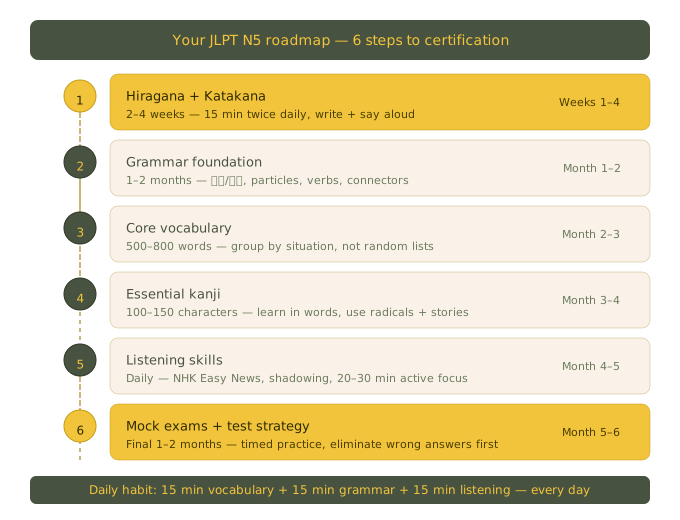
Here’s your roadmap to N5 success. I’ve structured this plan based on what actually works for real students, not theoretical perfection.
Step 1: Master Hiragana & Katakana (2-4 weeks) 📝
Why This Matters: You absolutely cannot skip this step. Trying to learn Japanese without knowing hiragana and katakana is like trying to read English while blindfolded.
How to Do It Right:
- Week 1,2: Focus entirely on hiragana. Use the “stroke order matters” approach—write each character 10 times while saying it aloud.
- Week 3,4: Tackle katakana using the same method. Many characters look similar to hiragana, so make comparison charts.
- Daily Practice: Use flashcard. Aim for 15-20 minutes twice daily.
Pro Tip: Create silly mnemonics for difficult characters. For example, け (ke) looks like a key, and つ (tsu) looks like a tsunami wave.
Recommended :
- NihongoKnow’s learning Hiragana in 12days and Katakana in 10days.
- Real Kana app for mobile practice
More about Hiragana and Katakana ?
Check
・Master Hiragana in 2 Weeks: Your Complete Beginner’s Guide to Japanese Writing
・🇯🇵 Hiragana vs. Katakana: A Clear, Beginner-Friendly Guide !
Step 2: Build Your Grammar Foundation (1-2 months) 📚
The Big Picture: N5 grammar isn’t about memorizing rules—it’s about understanding patterns that help you express basic ideas.
Essential Grammar Points to Master:
Week 1-2: Basic Sentence Structure
- です/である (polite/casual “to be”)
- XはYです (X is Y) – the most important pattern in Japanese
- Question formation with か
Starting from here !
Why Japanese Particles Are So Difficult (And How to Master Them)
🎯 Master Japanese Particles: The Complete Guide to は (wa) and も (mo)
Week 3-4: Verb Basics
- Present tense: します/しません (do/don’t do)
- Past tense: しました/しませんでした (did/didn’t do)
- Common verbs: 食べます (eat), 飲みます (drink), 行きます (go)
More details ?
The Complete Beginner’s Guide to Japanese Verb Conjugation: Master It Step by Step (2025 Edition)
Week 5-6: Practical Expressions
- Time expressions: 今日 (today), 昨日 (yesterday), 明日 (tomorrow)
- Location words: ここ (here), そこ (there), あそこ (over there)
- Question words: 何 (what), どこ (where), いつ (when)
Important words to make natural!
Read Natural Japanese Fillers: Mastering “Etto,” “Anoo,” and More.
Week 7-8: Connecting Ideas
- と (and), でも (but), そして (then)
- から (because), ので (because – softer)
Study Strategy: Don’t just memorize—create your own example sentences. If you’re learning 食べます (to eat), make sentences about foods you actually like: “私はピザを食べます” (I eat pizza).
Step 3: Build Your Core Vocabulary (500-800 words) 🗣️
The Smart Approach: Focus on high-frequency words you’ll actually use, not random vocabulary lists.
Priority Categories:
Everyday Essentials (150 words):
- Numbers: 一、二、三… 十、百、千
- Time: 時間 (time), 分 (minute), 時 (hour), 日 (day)
- Family: 家族 (family), 母 (mother), 父 (father), 兄 (older brother)
Daily Actions (200 words):
- 食べる (eat), 飲む (drink), 寝る (sleep), 起きる (wake up)
- 見る (watch/see), 聞く (listen/hear), 読む (read), 書く (write)
- 行く (go), 来る (come), 帰る (return home)
Essential Adjectives (100 words):
- 大きい (big), 小さい (small), 新しい (new), 古い (old)
- 美味しい (delicious), まずい (tasty – negative), 高い (expensive/tall)
Study Technique: Use the “context clustering” method. Instead of learning random words, group them by situations: “At a restaurant,” “Shopping,” “Describing people.”
Step 4: Conquer Essential Kanji (100-150 characters) ✍️
Mindset Shift: Don’t think of kanji as “difficult pictures to memorize.” Think of them as “shortcuts that make reading faster.”
The Logical Learning Order:
Numbers & Time (20 kanji): 一、二、三、四、五、六、七、八、九、十 日、月、年、時、分、週、今、毎
People & Relationships (15 kanji): 人、男、女、子、学、生、先、友、家
Actions & Movement (25 kanji): 行、来、見、聞、食、飲、買、読、書、話
Places & Directions (20 kanji): 学校、駅、店、車、電車、右、左、上、下
Here is more details : JLPT N5 Kanji List: Complete Guide with Memory Techniques for Beginners
Effective Kanji Study Methods:
- Radical Recognition: Learn the building blocks (radicals) first. 木 (tree) appears in 森 (forest) and 林 (woods).
- Story Method: Create memorable stories. 休 (rest) shows a person (人) leaning against a tree (木).
- Writing Practice: Write each kanji 10 times while saying all its readings aloud.
- Context Learning: Always learn kanji in words, not isolation. Learn 食べる (taberu – to eat), not just 食.
Step 5: Develop Your Listening Skills (Daily Practice) 👂
The Challenge: Listening is often the hardest section for self-study students because you need exposure to natural speech patterns and rhythm.
Your Daily Listening Menu:
Beginner-Friendly Content (15-20 minutes daily):
- NHK Easy News (simplified Japanese news)
- JLPT N5 listening practice videos on YouTube
- Nihongo con Teppei (Beginner) podcast
Entertainment That Teaches (20-30 minutes daily):
- Children’s anime (simple vocabulary, clear pronunciation)
- Japanese learning YouTube channels (Japanesepod101, Learn Japanese with Yuta)
- Language exchange apps with voice messages
Active Listening Techniques:
- Shadow Reading: Play audio and try to repeat what you hear, even if you don’t understand everything.
- Prediction Practice: Pause mid-sentence and guess what comes next.
- Speed Variation: Use apps that let you slow down audio to 0.75x speed initially.
Common Listening Mistakes to Avoid:
- Don’t just have Japanese playing in the background—actively focus
- Don’t get frustrated if you only catch 20-30% initially—that’s normal
- Don’t skip the “boring” JLPT practice audio—it matches the test format
Check step by step 🎧 Master JLPT Listening: Proven Strategies to Boost Your Score
Step 6: Test Preparation & Mock Exams (Final 1-2 months) 📝
Strategic Test Prep: This isn’t just about reviewing—it’s about getting comfortable with the test format and timing.
Essential Practice Materials:
- Official JLPT Practice Workbook (get the real thing, not knockoffs)
- JLPT N5 past papers (available online)
- Timing practice with full-length mock tests
Test-Taking Strategy Sessions:
Reading Section Tips:
- Skip difficult passages initially—answer easy questions first
- Look for key words you recognize rather than trying to understand everything
- Practice educated guessing techniques
Listening Section Tips:
- Read questions before audio starts (when possible)
- Take notes on numbers, times, and locations
- Don’t panic if you miss something—stay focused on the next question
Vocabulary/Grammar Section Tips:
Budget your time: don’t spend 5 minutes on one difficult question
Trust your first instinct—don’t second-guess too much
Eliminate obviously wrong answers first
📚 Best JLPT N5 Study Resources
Let me share the resources that actually work, based on feedback from hundreds of successful N5 students.
Textbooks That Actually Teach Well
Genki I (Beginner) – $60
- Pros: Excellent progression, engaging dialogues, comprehensive grammar explanations
- Cons: Expensive, requires workbook for full experience
- Best For: Structured learners who like traditional textbook approaches
Minna no Nihongo I – $45
- Pros: Widely used, lots of supplementary materials available, grammar-focused
- Cons: Japanese explanations (need translation book), less engaging than Genki
- Best For: Serious students who want depth over entertainment
Japanese From Zero! Book 1 – $25
- Pros: Very beginner-friendly, introduces hiragana gradually, affordable
- Cons: Slower pace, less comprehensive than other options
- Best For: Complete beginners who feel overwhelmed by traditional textbooks
Mobile Apps That Actually Help
Anki (Free/Premium $25/year)
- Why It Works: Spaced repetition system scientifically proven to improve retention
- How to Use: Download pre-made N5 decks, review 20-30 cards daily
- Pro Tip: Make your own cards for words you struggle with
Bunpo ($10/month)
- Strengths: Gamified grammar learning, great explanations, progress tracking
- Best Feature: Grammar exercises that feel like games, not homework
JLPT Tango N5 ($3)
- Focus: Vocabulary building with example sentences
- Unique Feature: Audio from native speakers, contextual learning
Spotify/Apple Music Japanese Learning Playlists
Tip: Start with children’s songs—simple vocabulary, clear pronunciation
Search For: “JLPT N5 Listening,” “Japanese Learning Songs”
If you would like to see more about materials, you can also read Best Books for JLPT Preparation 2025: Complete Study Guide for Every Level (N5–N1) .
✅ 10 Pro Tips That Actually Work for N5 Success
These aren’t generic study tips—these are specific strategies that successful N5 students swear by.
1. The “Daily 15-15-15” Rule
Spend 15 minutes each on vocabulary, grammar, and listening every single day rather than cramming 2 hours once a week. Consistency builds habits, and habits build fluency.
2. Don’t Skip Kanji Writing Practice
Even though JLPT is multiple choice, writing kanji by hand creates muscle memory that dramatically improves recognition speed during the test.
3. Learn Grammar Through Sentences, Not Rules
Instead of memorizing “と means ‘and’ in Japanese,” learn complete sentences like “コーヒーと紅茶を飲みます” (I drink coffee and tea). Your brain remembers patterns better than abstract rules.
4. Use the “Explain It to a Child” Test
If you can’t explain a grammar point in simple terms, you don’t really understand it yet. Practice explaining Japanese concepts in English—it reveals gaps in your knowledge.
5. Create Your Own Error Log
Keep a notebook of mistakes you make repeatedly. Review this weekly. Most students make the same 10-15 errors over and over—identifying them is half the battle.
6. Study With Japanese Audio Playing
Even when doing written exercises, have Japanese audio playing softly in the background. This trains your ear to Japanese rhythm and intonation subconsciously.
7. The “One New Thing Daily” Challenge
Learn one new piece of Japanese every day—a word, grammar pattern, or cultural fact. Small, consistent additions compound into significant knowledge.
8. Practice “Speed Recognition” Weekly
Set a timer and see how quickly you can read through hiragana, katakana, or kanji charts. Speed matters on the actual test.
9. Find Your “Japanese Anchor”
Connect your study to something you already love—Japanese food, anime, music, culture. Passion sustains motivation when discipline wavers.
10. Join Online Communities
Reddit’s r/LearnJapanese, Discord Japanese learning servers, and Facebook groups provide accountability, answers to questions, and motivation from fellow learners.
⚠️ Beyond JLPT: Building Real Japanese Communication Skills
Haruka’s take: This is the part I feel most strongly about. I’ve seen students pass N5 and still freeze completely when a Japanese person speaks to them at a normal pace. The test and the language are not the same thing. At NihongoKnow, I always tell N5 students: the certificate opens a door, but real conversation is what’s on the other side. Build both at the same time, don’t wait until N4 to start speaking.
Here’s something most Japanese learning blogs won’t tell you: passing JLPT N5 doesn’t mean you can have real conversations in Japanese.
What JLPT N5 Actually Proves
JLPT N5 certification shows you can:
- Recognize written Japanese in controlled, test-like conditions
- Understand very clear, slow speech about familiar topics
- Use basic grammar patterns in structured exercises
What JLPT N5 Doesn’t Guarantee
However, it doesn’t necessarily mean you can:
- Have spontaneous conversations with native speakers
- Understand natural speech at normal speed
- Express complex thoughts or emotions
- Navigate unexpected situations in Japanese
The Solution: Balance Test Prep with Real Communication
While Studying for N5:
- Practice speaking aloud daily, even if you’re alone
- Try language exchange apps like HelloTalk or Tandem
- Join online Japanese conversation groups
- Watch unscripted Japanese content (vlogs, reality shows)
After Passing N5:
- Consider working toward N4, but also focus on conversation skills
You are ready to check this article ; Why JLPT N4 Grammar Is Difficult - Take italki lessons with native speakers
- Try shadowing exercises with natural Japanese content
- Practice writing daily journal entries in Japanese
The Real Goal
Think of JLPT N5 as your “learner’s permit” for Japanese—it proves you understand the basics, but real fluency comes from actual practice and use. The test is a milestone, not the destination.
And you finally reach the level to take exam ? Don’t forget to know what you have to do on exam day
: JLPT Exam Day Essentials: What to Bring & Key Tips for Success
🚀 Ready to Start? Your Next Steps
You’ve got the roadmap, now it’s time to take action. Here’s how to begin your JLPT N5 journey today.
Week 1 Action Plan
Day 1-2: Download Anki and a hiragana practice app. Start with 10 characters.
Day 3-4: Add katakana practice. Continue hiragana review.
Day 5-7: Begin basic vocabulary (greetings, numbers 1-10). Keep practicing syllabaries.
Month 1 Goals
- Master all hiragana and katakana
- Learn 50 basic vocabulary words
- Understand です/だ sentence patterns
- Complete first chapter of chosen textbook
Your 6-Month Milestone Checklist
By test time, you should be able to:
- ✅ Read simple Japanese sentences without hesitation
- ✅ Recognize 500+ vocabulary words
- ✅ Write and recognize 100+ kanji
- ✅ Understand slow, clear Japanese speech
- ✅ Complete practice tests within time limits
Finding Your Support System
Join NihongoKnow Community: Connect with other N5 students, get expert guidance, and access structured lesson plans designed specifically for beginners.
Local Resources: Check if your local community college offers Japanese classes, or look for Japanese cultural centers and conversation meetups.
Online Accountability: Find study buddies on social media or language learning forums. Regular check-ins keep you motivated during challenging periods.
The Most Important Tip
Start today, not tomorrow. Download one app, watch one YouTube video, or write out the first five hiragana characters. The perfect study plan means nothing without action.
Your journey to understanding Japanese starts with a single step. JLPT N5 is absolutely achievable with consistent effort and the right approach. You’ve got this!
Final Thoughts: Your Japanese Adventure Begins Now
Learning Japanese isn’t just about passing a test—it’s about opening doors to a fascinating culture, connecting with millions of people, and proving to yourself that you can master challenging goals.
JLPT N5 might seem daunting now, but thousands of students pass it every year. With dedication, the right resources, and a solid study plan, you’ll be celebrating your success in just a few months.
Ready to begin? Your future self who can understand Japanese is waiting for you to take the first step.
Have questions about JLPT N5 preparation? Want personalized guidance for your learning journey? Contact NihongoKnow today and let our experienced teachers help you succeed faster than you thought possible.


