

Picture this: You’re sitting in your favorite Vancouver café, confidently reading a Japanese newspaper, when suddenly you encounter a kanji that looks like someone spilled ink on the page. You squint, rotate the paper, maybe even ask your Japanese friend sitting nearby… and they’re just as confused as you are! 😅
Welcome to the world of 激ムズ漢字 (geki-muzu kanji) – super difficult kanji that challenge even native Japanese speakers. While most Japanese language students in Vancouver focus on the standard 2,136 常用漢字 (jouyou kanji), there’s a whole universe of complex characters that will make you appreciate why Japanese people sometimes choose to write in hiragana instead!
Whether you’re studying at UBC, preparing for advanced JLPT levels, or simply curious about the extremes of Japanese writing, this deep dive into impossibly difficult kanji will both fascinate and possibly terrify you. But don’t worry – we’ll also give you practical strategies to approach these monsters with confidence! 🦸♀
A note from Haruka: I still remember the first time a student showed me 鬱 and asked me to write it from memory. I’m a native Japanese speaker and a trained teacher, and I had to think about it for a full minute before I was confident I had it right. That moment actually became one of my favorite teaching stories, because it tells students something important: struggling with kanji is not a sign you’re failing. It’s a sign you’ve reached the interesting part.
️📋 Quick View:
Reality Check: Even native speakers struggle with these – don’t feel bad if you find them impossible! 🤯
Reading Time: 10 minutes
Difficulty Level: Intermediate to Advanced
Key Takeaway: Understand why some kanji are extremely difficult and learn strategies to tackle them
Best For: Japanese learners in Vancouver and beyond who want to understand kanji complexity
- ️📋 Quick View:
- 🤔 What Makes a Kanji "Super Difficult"?
- 🏆 Top 10 Extremely Difficult Kanji (Ranked by Difficulty)
- 🧠 Why Even Native Speakers Struggle with These Kanji
- 💡 Strategic Approaches to Difficult Kanji
- 🎓 Do You Really Need to Learn These Difficult Kanji?
- 🚀 Your Kanji Mastery Action Plan
- 🏆 Celebrating Your Kanji Journey
🤔 What Makes a Kanji “Super Difficult”?
Before we dive into our top 10 list, let’s understand what makes certain kanji so challenging that even Japanese professors sometimes need to look them up:
📊 Complexity Factors:
- 🖊️ Stroke Count: Some have 30+ strokes – imagine writing that by hand!
- 🔍 Visual Density: They look like abstract art rather than readable characters
- 📚 Rarity: Used so infrequently that most people encounter them maybe once in their lifetime
- 🏛️ Historical Usage: Often archaic terms from classical Chinese or old Japanese literature
- 📖 Context Specificity: Limited to highly specialized fields like medicine, law, or classical studies
🧠 Cognitive Challenges:
- Memory Overload: Too many components to remember effectively
- Pattern Recognition: Don’t follow standard radical combinations
- Muscle Memory: Nearly impossible to develop through regular writing practice
- Context Clues: Rarely appear with helpful surrounding characters
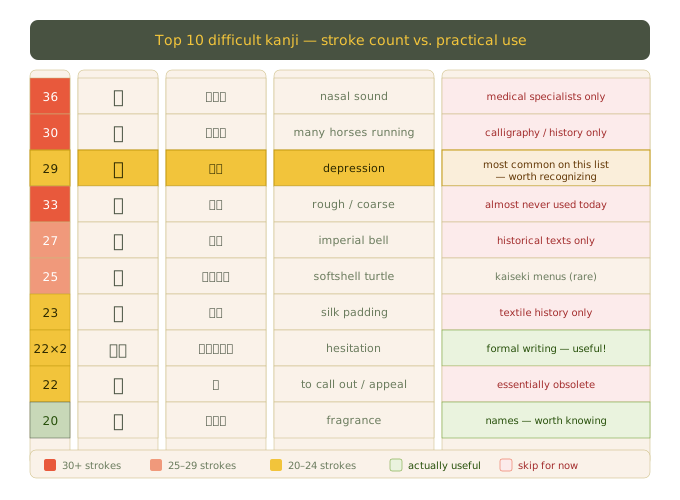
🏆 Top 10 Extremely Difficult Kanji (Ranked by Difficulty)
1. 鬱(うつ)– Depression
👑 The Ultimate Boss Kanji
| Stroke Count | 29 strokes |
| Frequency | Common in medical/psychological contexts |
| Main Usage | 鬱病(うつびょう)= depression |
| Why It’s Nightmare Fuel | Looks like a maze of lines; even doctors often write it in hiragana |
🎯 Vancouver Learning Tip: You’ll see this kanji in Japanese mental health resources at Vancouver General Hospital or UBC’s counseling services. Many Japanese medical professionals in Vancouver admit they prefer writing うつ in hiragana!
📝 Memory Trick: Think of it as a “tangled forest” (木 trees) where someone feels lost and confused – just like the character itself!
Haruka’s take: 鬱 is the kanji I use to open every advanced kanji discussion in my Vancouver classes. I put it on the board, ask students to count the strokes, and watch their faces. Then I tell them: ‘Your Japanese doctor probably writes this as うつ too.’ The relief in the room is immediate, and it leads to a much better conversation about when to use kanji vs. hiragana than any textbook explanation could.
2. 驫(ひょう)– Many Horses Running
🐎 The Triple Threat
| Stroke Count | 30 strokes |
| Frequency | Extremely rare, mostly historical |
| Main Usage | Classical texts, names, artistic calligraphy |
| Visual Impact | Three 馬 (horse) characters stacked together |
🎨 Cultural Context: This kanji represents the thundering sound of many horses galloping – you can almost hear it when you look at the character! It’s popular in Japanese calligraphy exhibitions in Vancouver’s cultural centers.
🧩 Learning Strategy: Remember “triple horse power” – three horses running together create tremendous force and noise.
3. 齉(びょう)– Nasal Sound/Speech Impediment
👃 The Medical Monster
| Stroke Count | 36 strokes |
| Frequency | Medical/linguistic terminology only |
| Main Usage | 齉音(びょうおん)= nasal sound |
| Professional Use | Speech therapy, medical diagnosis |
🏥 Vancouver Connection: Japanese speech therapists at BC Children’s Hospital might encounter this kanji in medical literature, but even they often use simpler alternatives in practice.
💡 Study Approach: Break it down into the “nose” radical (鼻) plus additional components – think of it as “extreme nose-related condition.”
4. 鑾(らん)– Imperial Bell/Carriage Bell
🔔 The Royal Relic
| Stroke Count | 27 strokes |
| Frequency | Historical documents only |
| Main Usage | Ancient imperial ceremonies, classical literature |
| Cultural Significance | Represents imperial power and ceremony |
🏛️ Historical Context: This kanji appears in texts about ancient Chinese and Japanese imperial courts – you might encounter it in advanced Japanese history courses at UBC or SFU.
📚 Academic Tip: Only tackle this if you’re studying classical Japanese literature or East Asian history at an advanced level.
5. 躊躇(ちゅうちょ)– Hesitation
🤷♀️ The Inseparable Pair
| Stroke Count | 22 strokes each |
| Frequency | Formal writing, literature |
| Main Usage | 躊躇する = to hesitate |
| Challenge | Never used separately – always as a pair |
💼 Business Context: You might see this in formal Japanese business documents in Vancouver’s Japan-Canada trade offices, though modern usage prefers simpler alternatives like ためらう.
🎭 Literary Usage: Common in Japanese novels and formal speeches – shows sophisticated vocabulary knowledge.
6. 麤(あら)– Rough/Coarse
🧱 The Visual Puzzle
| Stroke Count | 33 strokes |
| Frequency | Almost never used in modern Japanese |
| Visual Feature | Contains three 鹿 (deer) characters |
| Modern Alternative | 粗い(あらい)is used instead |
🔍 Fun Fact: This kanji is so rare that most Japanese people have never seen it outside of kanji trivia games or historical texts!
🎮 Gamification: Think of it as the “legendary rare” kanji – collecting it is more about achievement than practical use.
7. 馨(かおる)– Fragrance
🌸 The Aromatic Challenge
| Stroke Count | 20 strokes |
| Frequency | Names, poetry, classical texts |
| Main Usage | 馨(かおる)as a given name |
| Cultural Use | Traditional Japanese poetry, incense ceremony |
🌺 Vancouver Application: You’ll find this kanji in Japanese names at Vancouver’s Buddhist temples or in traditional Japanese art classes in Richmond.
💫 Name Recognition: Popular in Japanese names, especially for girls – shows elegance and refinement.
8. 纊(こう)– Silk Padding/Wadding
🧵 The Textile Specialist
| Stroke Count | 23 strokes |
| Frequency | Technical/historical texts only |
| Main Usage | Traditional textile terminology |
| Modern Relevance | Fashion history, traditional crafts |
🎨 Cultural Craft: Might appear in Japanese textile arts classes or traditional craft workshops in Vancouver’s Japanese cultural centers.
🏺 Historical Context: Related to traditional Japanese silk-making processes – fascinating but highly specialized knowledge.
9. 籲(よ)– To Call Out/Appeal
📢 The Forgotten Cry
| Stroke Count | 22 strokes |
| Frequency | Classical Chinese, very rare in Japanese |
| Main Usage | Historical documents, classical literature |
| Modern Status | Essentially obsolete |
📖 Academic Interest: Only relevant for advanced students of classical Chinese or Japanese literature at graduate level.
🎓 University Context: Might appear in advanced East Asian studies programs at UBC or SFU, but even professors might need to look it up!
10. 鼈(すっぽん)– Softshell Turtle
🐢 The Culinary Cryptic
| Stroke Count | 25 strokes |
| Frequency | Cuisine, traditional medicine |
| Main Usage | すっぽん料理 = softshell turtle cuisine |
| Cultural Context | Traditional Japanese and Chinese cuisine |
🍽️ Vancouver Foodie Connection: You might encounter this at high-end Japanese restaurants in Vancouver that serve traditional kaiseki cuisine, though most menus use hiragana instead!
🥢 Culinary Culture: Softshell turtle is considered a delicacy in traditional Japanese cuisine, believed to have health benefits.
🧠 Why Even Native Speakers Struggle with These Kanji
🎌 The Native Speaker Reality Check:
Educational Limitations:
- Most Japanese schools focus on the 2,136 常用漢字 (jouyou kanji)
- These difficult kanji aren’t part of standard curriculum
- Even Japanese university graduates might not know them
Modern Technology Impact:
- Computer input systems help with recognition but not memorization
- Many Japanese people rely on predictive text for complex kanji
- Handwriting skills have declined with digital communication
Practical Avoidance:
- Native speakers often choose simpler alternatives
- Hiragana substitution is socially acceptable
- Professional contexts may require specialized knowledge
🏫 Vancouver Japanese Community Insights:
Speaking with Japanese families in Vancouver’s Steveston area, many admit they struggle with these kanji too! Japanese parents helping their children with homework often need to look up complex characters, just like English speakers might need to check difficult vocabulary.
Professional Perspectives:
- Japanese doctors in Vancouver often write medical terms in katakana
- Business professionals use simplified forms in emails
- Even Japanese teachers sometimes avoid complex kanji in casual writing
💡 Strategic Approaches to Difficult Kanji
🎯 The Smart Learner’s Hierarchy:
Priority Level 1: Essential (Focus Here First)
- JLPT N5-N2 kanji (approximately 1,000 characters)
- Daily life vocabulary
- Basic business and academic terms
Just starting your kanji journey? JLPT N5 Kanji List: Complete Guide with Memory Techniques for Beginners covers the first 100 characters you actually need.
Priority Level 2: Useful (Intermediate Goal)
- Remaining 常用漢字 (jouyou kanji)
- Specialized vocabulary for your interests
- Regional variations and names
Priority Level 3: Interesting (Advanced Challenge)
- Complex kanji like our top 10 list
- Historical and classical literature
- Specialized professional terminology
🛠️ Practical Learning Strategies:
1. Radical Recognition Method 🧩
- Break complex kanji into familiar components
- Focus on understanding radical meanings
- Use radicals as memory anchors
Example with 鬱 (depression):
- Contains 木 (tree), 冖 (crown), 彡 (hair/pattern)
- Memory story: “Tangled trees under a heavy crown create confusion”
For a systematic approach to memorizing complex kanji, Kanji Memorization Hacks for Visual Learners: 10 Brain-Friendly Methods That Actually Work goes deep on the techniques that stick.
2. Context-First Approach 📖
- Learn kanji within sentences and situations
- Understand when and why they’re used
- Connect to real-world applications
Vancouver Practice:
- Visit Japanese bookstores in Richmond
- Read Japanese newspapers at the Central Library
- Practice with Japanese conversation groups
3. Technology Integration 📱
- Use kanji recognition apps for instant lookup
- Practice with spaced repetition systems (SRS)
- Watch Japanese content with subtitles
4. Cultural Immersion 🎎
- Attend Japanese cultural events in Vancouver
- Join calligraphy classes (learn stroke patterns)
- Practice with native speakers in language exchange
Vancouver Opportunities:
- Vancouver International Writers Festival (Japanese authors)
- Powell Street Festival (cultural immersion)
- Japanese cultural centers in Richmond and Burnaby
📊 The Progressive Difficulty Scale:
| Level | Stroke Count | Frequency | Learning Priority |
| Beginner | 1-10 strokes | Daily use | High |
| Intermediate | 11-15 strokes | Regular use | Medium |
| Advanced | 16-20 strokes | Occasional use | Low |
| Expert | 21+ strokes | Rare/specialized | Very Low |
🎓 Do You Really Need to Learn These Difficult Kanji?
📚 Academic Contexts:
YES, if you’re:
- Pursuing advanced Japanese literature studies
- Researching historical documents
- Studying traditional arts or medicine
- Aiming for native-level proficiency
NO, if you’re:
- Focusing on conversational Japanese
- Preparing for JLPT N5-N2
- Learning for travel or business
- Building basic literacy skills
🏢 Professional Contexts:
Potentially Useful For:
- Medical professionals working with Japanese patients
- Legal professionals handling Japanese documents
- Academic researchers in East Asian studies
- Cultural preservation specialists
Not Necessary For:
- Business communication
- Tourism industry
- General translation work
- Everyday conversation
🌍 Vancouver-Specific Considerations:
Local Japanese Community:
- Most Japanese residents use simplified forms
- Business contexts rarely require complex kanji
- Cultural events may feature traditional forms
Educational Opportunities:
- UBC and SFU offer advanced Japanese literature courses
- Community centers provide cultural context
- Language schools focus on practical applications
Choosing the right study materials makes all the difference. Best Books for JLPT Preparation covers resources for every level from N5 to N1.
🚀 Your Kanji Mastery Action Plan
🎯 Phase 1: Foundation Building (Months 1-6)
- Master basic 1,000 kanji for daily communication
- Focus on stroke order and proper writing technique
- Build radical recognition skills
- Practice in context through reading and conversation
🎯 Phase 2: Intermediate Expansion (Months 7-18)
- Complete 常用漢字 (standard use kanji)
- Learn specialized vocabulary for your interests
- Tackle name recognition and regional variations
- Practice complex characters in limited contexts
🎯 Phase 3: Advanced Challenge (Months 19+)
- Explore difficult kanji like our top 10 list
- Study classical literature and historical texts
- Master professional terminology in your field
- Develop cultural appreciation for kanji complexity
📅 Weekly Practice Schedule:
- Monday: Review and practice stroke order
- Wednesday: Context reading with new kanji
- Friday: Cultural exploration and real-world application
- Weekend: Conversation practice and community engagement
🏆 Celebrating Your Kanji Journey
Remember, every kanji you learn is an achievement! Whether you’re tackling basic characters or challenging yourself with the complex ones we’ve covered today, you’re participating in one of the world’s most fascinating writing systems.
The Japanese writing system reflects thousands of years of cultural evolution, artistic expression, and scholarly tradition. Even if you never need to write 鬱 by hand, understanding its complexity gives you insight into the depth and richness of Japanese culture.
Your journey with difficult kanji isn’t just about memorization – it’s about cultural appreciation, intellectual challenge, and personal growth. Every stroke you write connects you to centuries of human creativity and communication.
🌟 Ready to master kanji the smart way? Join NihongoKnow.com for structured, practical kanji learning that focuses on what you actually need to know. Start with the basics, build confidence, and gradually tackle the challenges – we’ll guide you every step of the way!


