
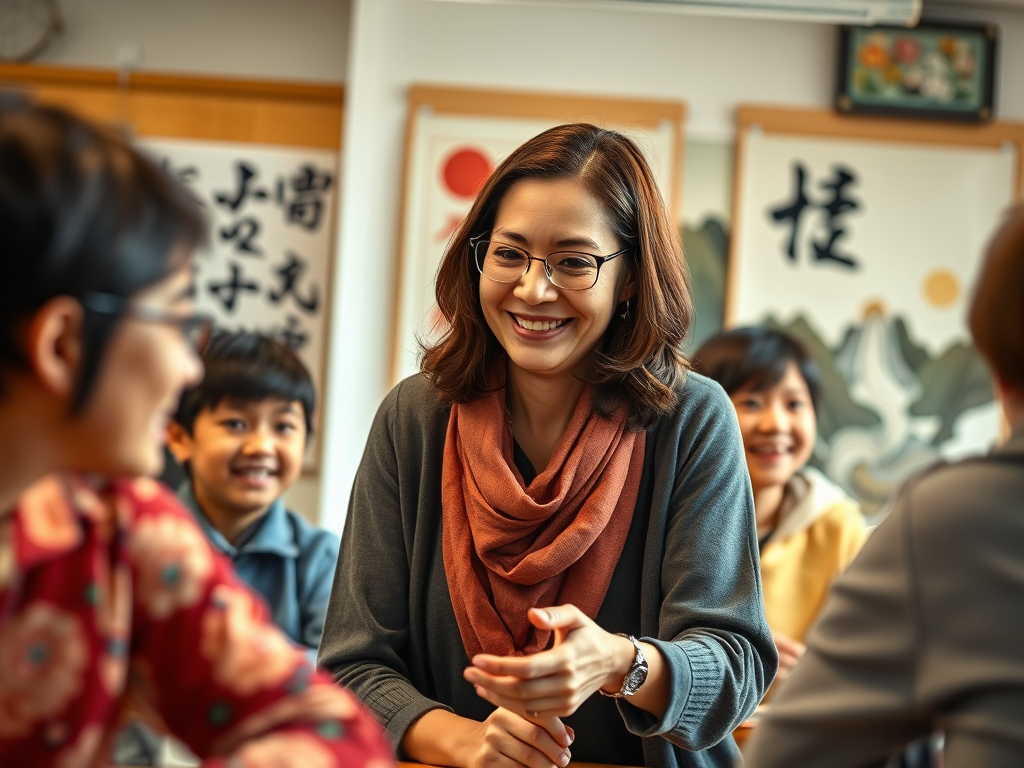
“I remember staring at English grammar rules, feeling completely lost. The teacher explained it perfectly—to them. But for me, a Japanese speaker trying to understand English, it might as well have been rocket science. That’s when I realized: the best teachers aren’t just experts in their subject—they’re experts in learning it.”
— Haruka Sensei, Founder of NihongoKnow
Have you ever sat in a Japanese class feeling like your teacher just doesn’t get how hard this is? Like they’re speaking from a world where Japanese grammar magically makes sense, while you’re still struggling to remember the difference between は and が?
You’re not imagining it. And there’s a reason why learning from a fellow language learner can transform your entire Japanese journey.
Learning from a Japanese teacher who is a language learner means learning from someone who truly understands your confusion, fear, and breakthroughs.
- 🎯 Why It Matters That Your Teacher Is a Language Learner Too
- 🤝 Why Second-Language Teachers Have a Secret Superpower
- 🏵️The Haruka Sensei Story: From Struggling Student to Empathetic Teacher
- 🔄 Mistakes Are Part of the Process—And That’s Okay
- 🗾What This Means for Your Japanese Learning Progress
- 🙆♀️The NihongoKnow Difference: Learning Together, Not Alone
- ❗Why This Matters More Than You Think
🎯 Why It Matters That Your Teacher Is a Language Learner Too
Don’t get me wrong—native Japanese speakers have incredible knowledge. They understand nuances, cultural context, and natural expressions that textbooks can’t capture. But here’s what many students don’t realize: being a native speaker doesn’t automatically make someone a great teacher for beginners.
The “Curse of Knowledge” Problem
Native speakers often suffer from what psychologists call the “curse of knowledge.” They know Japanese so intuitively that they’ve forgotten what it’s like to not know it.
Common scenarios you might recognize:
Student: “Why do we say ‘watashi wa’ but ‘watashi ni’? What’s the difference?”
Native speaker teacher: “Well, wa is the topic marker and ni is the direction marker. It’s just natural.”
Student thinking: “That doesn’t help me at all… I still don’t understand when to use which one.”
vs.
Second-language teacher: “I remember struggling with this exact same thing! Let me show you the trick I used. Think of wa as ‘speaking of…’ and ni as ‘toward…’ Here are three situations where I used to mess this up…”
The Grammar Explanation Gap
Native speakers learned Japanese grammar unconsciously as children. They never had to consciously study the rules that you’re wrestling with now. So when they try to explain grammar, they often:
- Use complex linguistic terms that confuse rather than clarify
- Skip over the “obvious” steps that aren’t obvious to learners
- Can’t relate to why certain concepts are difficult
- Focus on exceptions rather than practical patterns
The Emotional Distance
Perhaps most importantly, native speakers have never experienced the emotional journey of learning Japanese as an adult. They don’t know what it feels like to:
- Be embarrassed about pronunciation
- Feel overwhelmed by kanji
- Worry about using the wrong politeness level
- Have your mind go blank during conversation
- Feel like you’re not making progress fast enough
This emotional understanding is crucial for effective language teaching.
🤝 Why Second-Language Teachers Have a Secret Superpower
Teachers who learned Japanese as their second language bring something irreplaceable to the classroom: they’ve walked in your shoes. This gives them several unique advantages:
1. They Remember the Struggle (And the Breakthroughs)
A second-language teacher can tell you exactly:
- Which grammar points are genuinely difficult (not just “difficult for foreigners”)
- What mental tricks actually work for memorization
- How to overcome specific pronunciation challenges
- When you’re ready for the next level of complexity
They remember their own “aha!” moments and can recreate them for you.
2. They Speak Your Mental Language
When you think in English and try to express yourself in Japanese, your brain goes through a specific process. A teacher who has made this same mental journey can:
- Predict where your thinking will get stuck
- Provide translations that make sense to English speakers
- Explain Japanese concepts using English-friendly analogies
- Help you avoid common English-speaker mistakes
3. They Know What Actually Matters
Through their own learning experience, second-language teachers have developed practical wisdom about:
- Which grammar rules to prioritize
- What vocabulary is actually useful in daily life
- How much perfectionism is helpful vs. harmful
- When to push forward vs. when to consolidate
4. They Model Growth Mindset
Perhaps most importantly, a teacher who learned Japanese as an adult proves that it’s possible. They’re living proof that you can go from confusion to competence, from stumbling to fluency.age is connection. And that connection starts when your teacher sees you as more than a student—as a fellow learner.
🏵️The Haruka Sensei Story: From Struggling Student to Empathetic Teacher
Let me share the story behind NihongoKnow’s approach, because it perfectly illustrates why teacher empathy matters so much.
The Early Struggles
When Haruka first started learning English, she faced many of the same challenges you’re experiencing with Japanese:
The Grammar Confusion: “I remember spending hours trying to understand when to use ‘a’ versus ‘the.’ In Japanese, we don’t have articles at all! My English teacher would say ‘it’s natural’ or ‘you just know,’ but that didn’t help me at all. I felt so frustrated.”
The Speaking Anxiety: “I understood everything in my English classes, but when it came time to speak, I froze. I cried so much and was so afraid of making mistakes that I barely said anything. I knew my teacher was getting impatient with me, but I couldn’t explain that I wasn’t being difficult—I was just scared.”
The Cultural Disconnect: “American communication style was so different from Japanese style. I kept using Japanese politeness patterns in English, and people thought I was being weird or overly formal. No one explained to me that languages carry culture, not just words.”
The Breakthrough Moment
Everything changed when Haruka found an English school where she could learn English through conversation:
“Those teacher understood exactly what I was going through. When I made a mistake, instead of just correcting me, she’d say ‘Oh, I used to make that exact same mistake when I was learning English!’ Then she’d explain not just what was wrong, but why my Japanese brain was making that particular error.”
“For the first time, I felt understood. I felt like my struggles were normal and valid. That teacher helped me realize that making mistakes wasn’t a sign of failure—it was a sign of trying.”
The Teaching Philosophy Born
This experience shaped Haruka’s entire approach to teaching Japanese:
“I promised myself that if I ever became a language teacher, I would never forget what it felt like to be a confused student. I would remember that behind every grammar mistake is a person doing their best to communicate.”
This is the foundation of the NihongoKnow philosophy: empathy-driven language education.
🔄 Mistakes Are Part of the Process—And That’s Okay
When your teacher truly understands your learning journey, it transforms every aspect of your education:
Mistakes Become Learning Opportunities, Not Embarrassments
Traditional approach:
- Student makes mistake
- Teacher corrects it
- Student feels embarrassed
- Student speaks less to avoid mistakes
Empathetic approach:
- Student makes mistake
- Teacher says: “I made that exact same mistake for months! Here’s what helped me…”
- Student feels understood and encouraged
- Student speaks more, learns faster
Explanations Actually Make Sense
Example: Teaching the て-form
Native speaker explanation: “You change the ending based on the verb group. Group 1 verbs ending in う become って, verbs ending in く become いて…”
Second-language learner explanation: “I know this looks overwhelming—I felt the same way! Let me show you the pattern I used. First, don’t worry about memorizing all the rules. Start with just five common verbs you use every day. Once those feel automatic, the pattern will start making sense for other verbs too.”
Progress Is Measured Realistically
Teachers who have learned Japanese themselves understand:
- How long things actually take to sink in (based on experiences)
- What “normal” progress looks like
- When to push and when to be patient
- How to celebrate small victories
Cultural Context Comes Naturally
A teacher who has navigated Japanese culture as an outsider can help you:
- Understand why certain expressions exist
- Avoid cultural misunderstandings
- Build confidence in social situations
- Develop cultural sensitivity alongside language skills
🗾What This Means for Your Japanese Learning Progress
Learning with an empathetic, second-language teacher doesn’t just feel better—it actually accelerates your progress:
Faster Problem-Solving
When you get stuck, your teacher can quickly identify the issue because they’ve been there themselves. Instead of generic advice, you get targeted solutions.
More Efficient Study Methods
Your teacher can recommend study techniques that actually work for adult learners, not just theoretical “best practices.”
Reduced Anxiety
When you feel understood and supported, you’re more willing to take risks, make mistakes, and push your comfort zone—all essential for language learning.
Sustainable Motivation
Having a teacher who believes in your success (because they’ve achieved it themselves) helps you push through difficult periods without giving up.
Practical Focus
Teachers who learned Japanese as adults understand what you actually need to know versus what’s just academically interesting.
🙆♀️The NihongoKnow Difference: Learning Together, Not Alone
At NihongoKnow, our approach is built on methods that actually work for adult language learners:
The “Mistake-Friendly” Environment
- Every mistake is treated as valuable data
- Common errors are discussed openly and without shame
- Success stories of overcoming specific challenges are shared regularly
- Students are encouraged to experiment and take risks
The “Fellow Traveler” Mentality
- Teachers share their own learning stories and ongoing challenges
- Students realize they’re not alone in their struggles
- The classroom becomes a supportive community rather than a judgment zone
- Progress is celebrated together
The “Practical First” Approach
- Focus on what you actually need to communicate
- Grammar explanations that make sense to English speakers
- Cultural context based on real cross-cultural experience
- Study methods tested by fellow adult learners
Flexible Learning for Real Life
Whether you’re in Vancouver or learning online, NihongoKnow adapts to your reality:
In-Person Classes in Vancouver:
- Small groups with personalized attention
- Face-to-face encouragement and support
- Local cultural context and community building
- Immediate feedback and adjustment
Online Learning Options:
- Same empathetic approach via video calls
- Flexible scheduling for busy adults
- Digital tools that actually help (recommended by someone who’s used them)
- Global community of fellow learners
❗Why This Matters More Than You Think
Choosing a Japanese teacher isn’t just about finding someone who knows the language—it’s about finding someone who understands the journey you’re on.
When your teacher has walked your path:
- Every lesson feels relevant and achievable
- Mistakes become stepping stones, not roadblocks
- Progress is measured with understanding and patience
- Success feels not just possible, but inevitable
When your teacher truly gets it:
- You’ll find your voice sooner
- You’ll build confidence faster
- You’ll develop genuine cultural competence
- You’ll actually enjoy the learning process
The Empathy Advantage Is Real
Research in language acquisition shows that students learn faster and retain more when they feel understood and supported. But beyond the research, there’s something deeply human about learning from someone who has faced your exact challenges and emerged successful.
At NihongoKnow, we don’t just teach Japanese—we guide fellow travelers on a journey we’ve taken ourselves.
Your Japanese Journey Starts with Understanding
You don’t have to struggle alone. You don’t have to feel embarrassed about your challenges. You don’t have to wonder if you’re “cut out for this.”
Choosing a Japanese teacher who is a language learner can completely change how confident and motivated you feel in your studies.
You just need a teacher who remembers what it’s like to be you.
Ready to experience the empathy difference in Japanese learning?
Let’s learn together. 🤝🇯🇵
NihongoKnow – Where Learning Meets Understanding. Founded by fellow language learners, for fellow language learners. Serving Vancouver and online students worldwide.